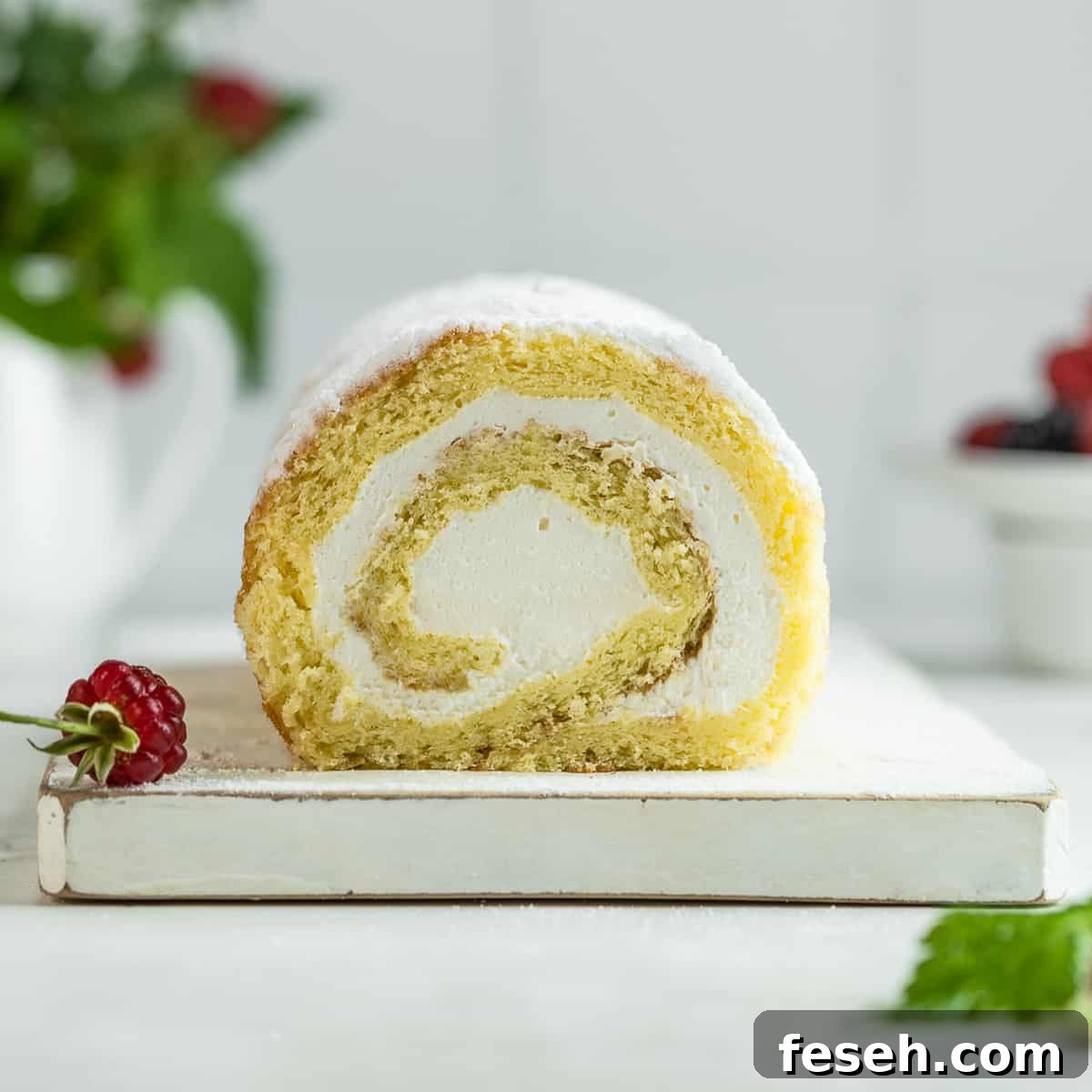
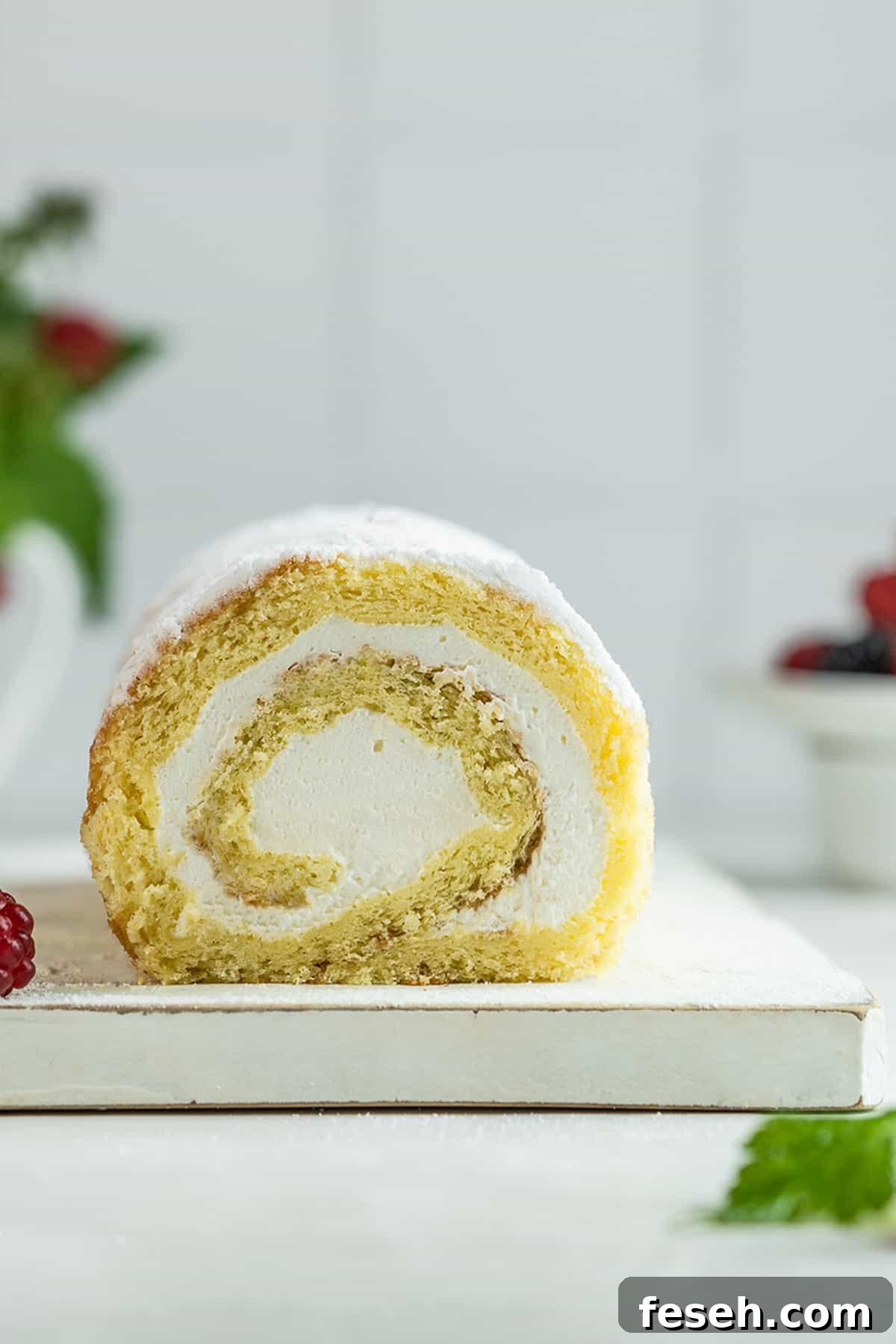
This vanilla sponge cake roll is simple, fast, and made from a handful of everyday ingredients scented with vanilla. It’s an ideal base for Swiss rolls, jelly rolls, Yule logs and Buche de Noël, delivering a soft, airy sponge that rolls beautifully without using chemical leaveners.
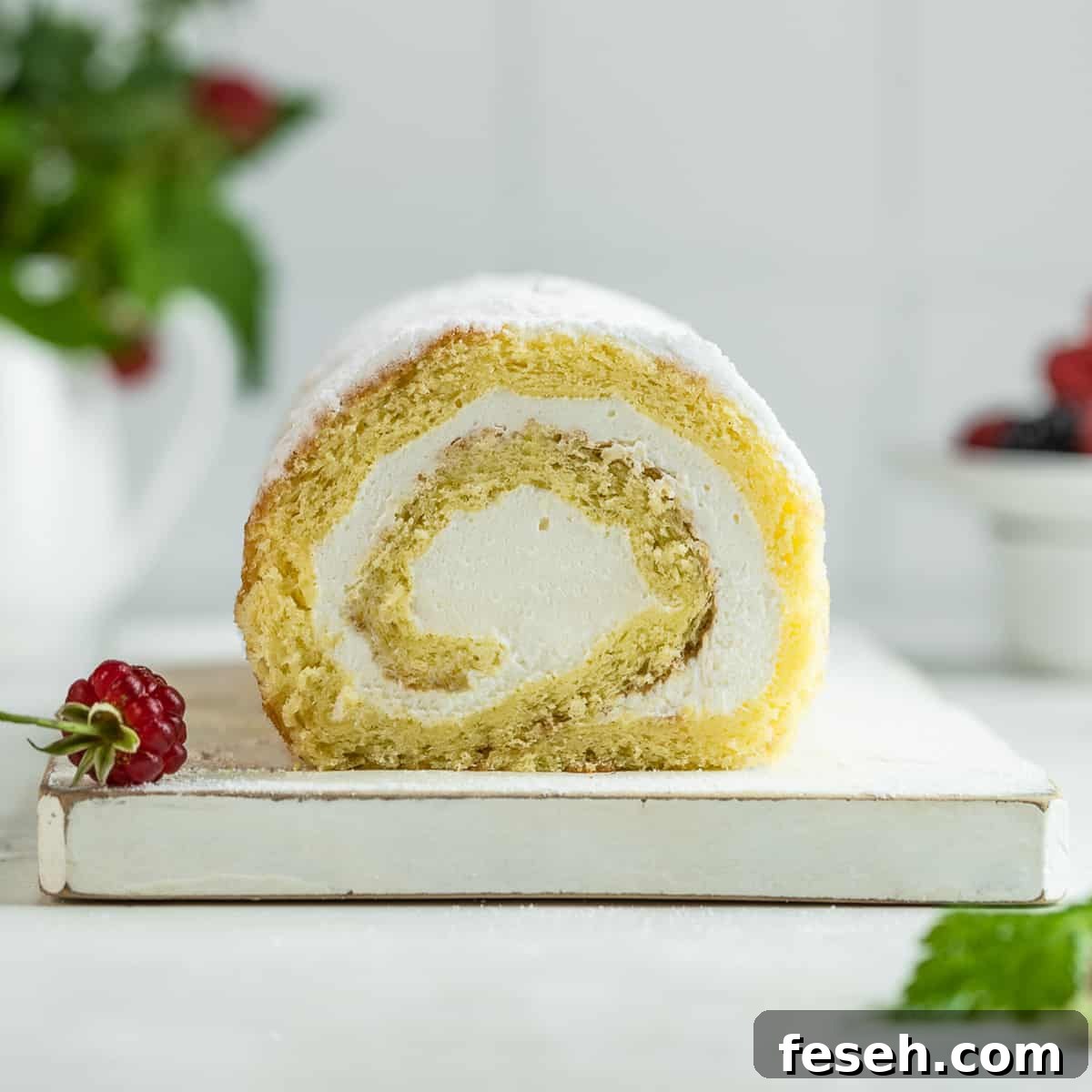
Vanilla sponge cake roll recipe
This recipe uses whole eggs beaten until light and voluminous so the cake rises from air incorporated into the batter rather than baking powder or soda. The result is a tender, flexible sponge perfect for rolling and filling with cream, jam or ganache. The same approach is commonly used for Genoise and Italian sponge cakes.
Ingredients
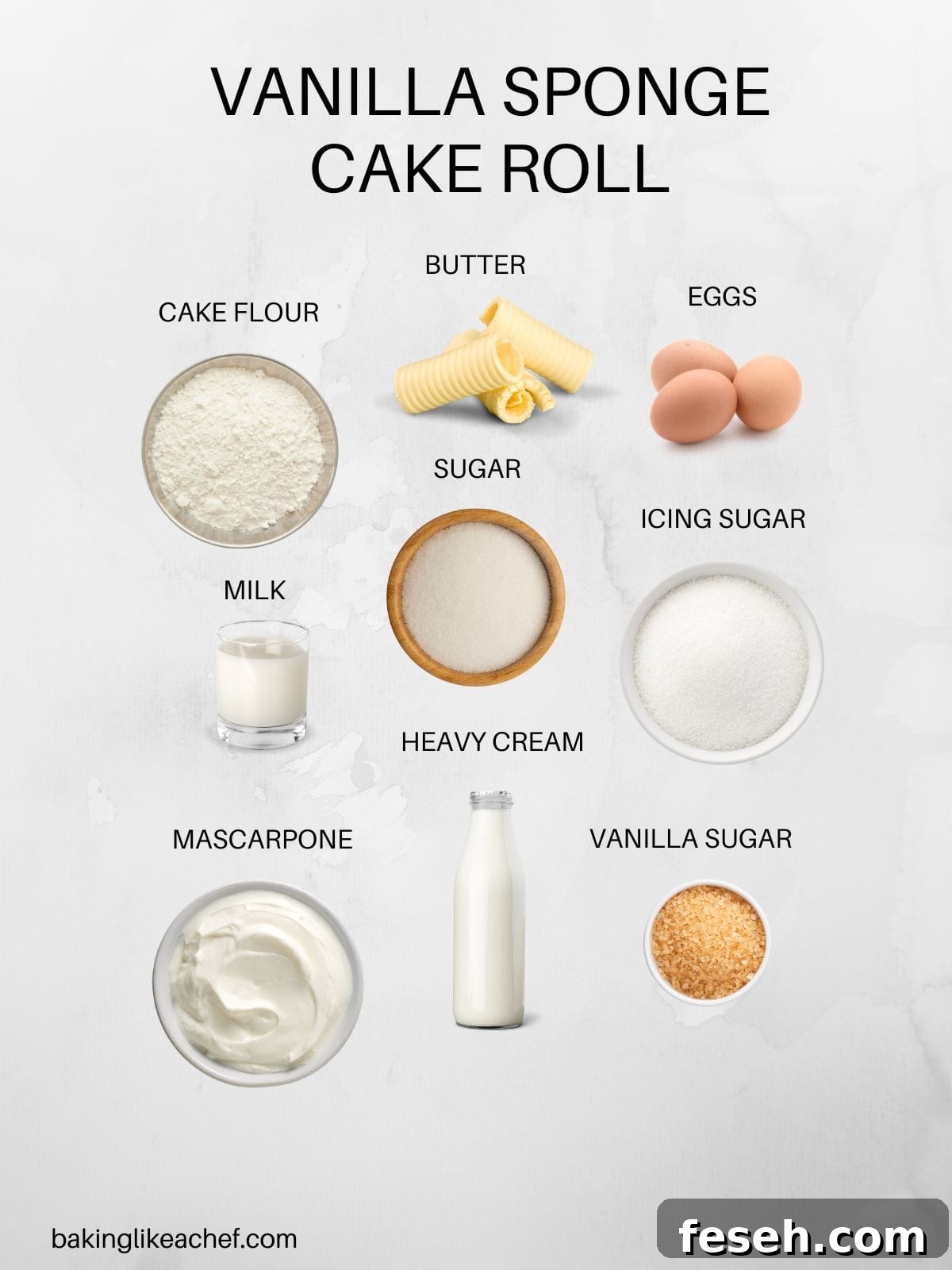
For exact ingredient quantities and a printable layout, see the recipe card below.
- Eggs: Use large eggs at room temperature. No separation of whites and yolks is required.
- Sugar: Granulated sugar for the batter and icing (powdered) sugar for dusting and frosting.
- Flour: Cake flour gives the lightest texture. To substitute cake flour, replace 2 tablespoons of each cup of all-purpose flour with cornstarch.
- Milk: Whole milk produces the best tenderness.
- Butter: Unsalted butter is recommended; you can substitute a neutral vegetable oil if you prefer.
- Heavy cream: Use heavy cream (30% fat or higher) for a stable whipped mascarpone filling.
- Mascarpone: Adds a pleasant tang and helps stabilize the whipped filling.
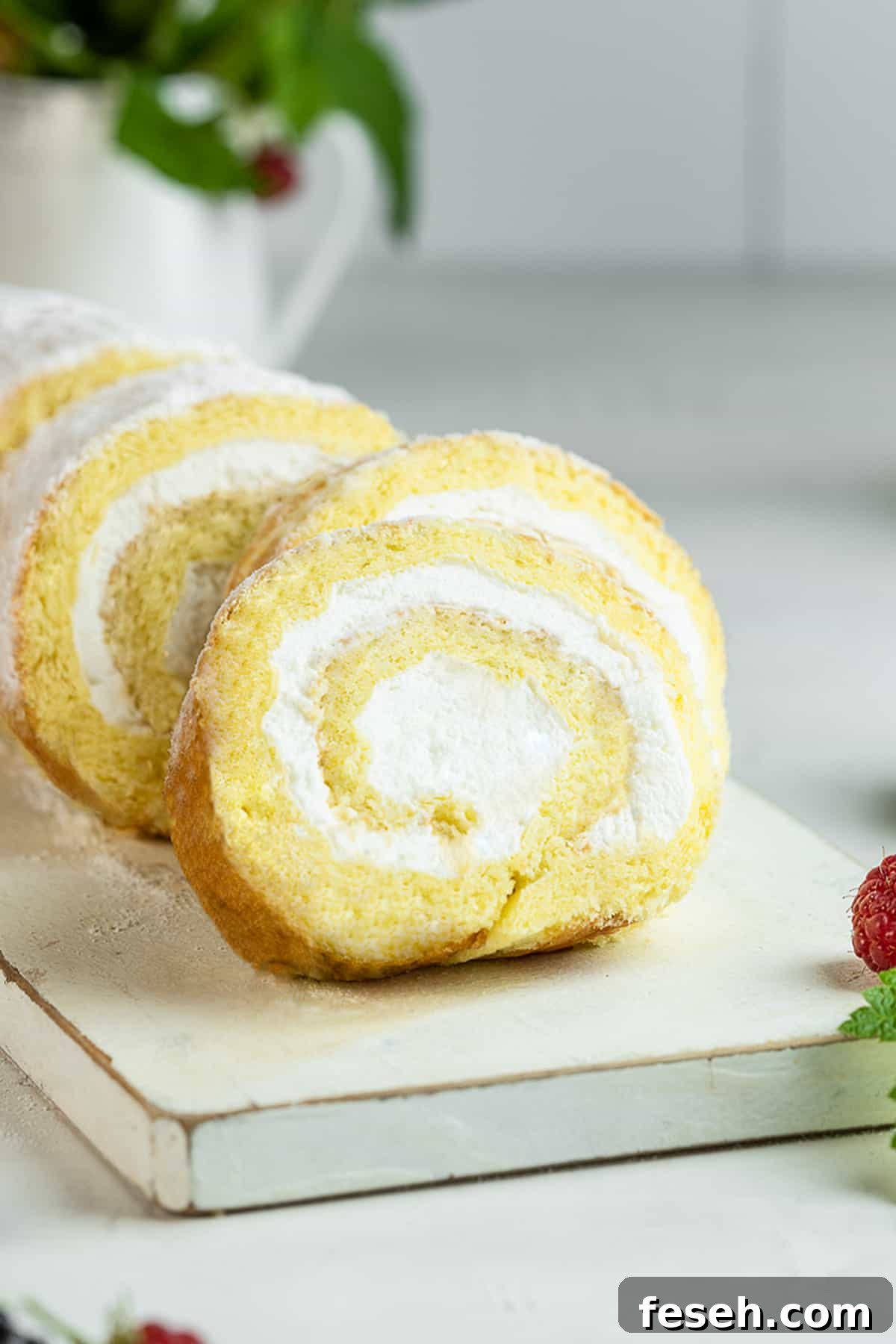
How to make the sponge cake roll
Step 1. Prepare a 12 x 16 inch (30 x 40 cm) non-spill baking sheet or large tray lined with parchment paper.
Step 2. Preheat the oven to 390°F (200°C). Sift the cake flour and set aside.
Step 3. Combine milk and butter in a small bowl and warm over a hot water bath until the mixture reaches about 122–150°F (50–60°C).
Step 4. In a heatproof bowl, place room-temperature whole eggs, vanilla and granulated sugar. Whisk briefly by hand to combine.
Step 5. Set the bowl over the water bath and whisk until the egg mixture reaches roughly 104°F (40°C) when checked with a thermometer.
Step 6. Remove from the bath and beat with an electric or stand mixer using the whisk attachment on high speed for 6–7 minutes until the mixture thickens, lightens in color and increases about threefold.
Step 7. When the batter falls in a thick ribbon from the whisk and feels stable, lower the mixer speed and beat a further 1–2 minutes to refine the texture.
Step 8. Sift the flour over the whipped eggs and fold gently with a rubber spatula, working from the bottom upward while turning the bowl.
Step 9. Stir a few tablespoons of the warm milk-and-butter mixture into a scoop of batter to temper it, then fold that back into the main bowl. Fold gently to keep as much air as possible.
Step 10. Pour the batter onto the prepared sheet about 8 inches (20 cm) above the pan to help burst large bubbles. Spread into a 12 x 16 inch (30 x 40 cm) rectangle about ½ inch (1 cm) thick and level with a spatula.
Pro tip: Tap the pan lightly on the countertop to release trapped air and avoid over-smoothing the surface.
Step 11. Bake, immediately reducing the oven from 390°F (200°C) to 375°F (190°C), for 12–14 minutes. The cake should be slightly browned on top but pale on the bottom; test with a toothpick — it should come out clean.
Step 12. Remove the hot cake and flip it onto a clean tea towel generously dusted with icing (powdered) sugar. Peel off the parchment or silicone sheet and cover the cake with another sheet of clean parchment.
Step 13. Using the towel, roll the cake with the parchment inside and let it rest rolled for 10 minutes, then unroll and cool completely to room temperature.
Step 14. For the mascarpone whipped cream, chill a bowl and whisk, then whip cold heavy cream and cold mascarpone until soft peaks form. Add icing sugar and whisk to medium-stiff peaks.
Step 15. Unroll the cooled cake, remove the parchment and spread the mascarpone cream evenly with an offset spatula. Re-roll from the short end, using the towel to keep the roll tight and even.
Step 16. Place the seam on the bottom, tighten the roll (use a long ruler or flat baking sheet to keep it straight) and refrigerate wrapped in the towel for 30–60 minutes. Trim the ends with a serrated knife before serving.
To serve: Dust the top with icing sugar and garnish with fresh fruit, chocolate shavings or a dusting of cocoa, depending on your filling and decoration preference.
Expert tips
- Rolling is the crucial step: roll the cake warm in a tea towel to set the shape, then unroll once cooled to add filling and re-roll tightly.
- Don’t overbake — an overbaked sheet will crack when rolled. The top should be only lightly colored.
- Cool the cake completely before applying the filling to prevent a runny or sloppy roll.
- For different pan sizes, adjust quantities proportionally to maintain thickness and bake times.
Recipe variations
- Chocolate sponge: Replace 10–20% of the cake flour with unsweetened cocoa powder for a rich cocoa sponge.
- Fillings: Try jam, chocolate ganache, Chantilly cream, or a cream cheese filling instead of mascarpone cream.
- Rolling style: Roll from the short side for classic spirals, or lengthwise for a longer log; try the browned side either in or out for a different finished look.
- Decoration: Dust with powdered sugar, pipe whipped cream, or top with fresh berries or chocolate curls.
Storing and freezing
Store the assembled sponge roll in an airtight container in the refrigerator for up to 2 days.
You can freeze a fully assembled and wrapped sponge roll (filled with mascarpone frosting) for up to 2 months; thaw overnight in the refrigerator before serving.
Recipe FAQ
Yes. Bake the sponge thinly (about ½ inch / 1 cm), dust with powdered sugar on a towel, roll it while warm, cool, then unroll to add filling and roll again for a neat Swiss roll.
After baking, flip the hot cake onto a sugared towel, remove the pan or parchment, roll the cake (parchment inside) and let it rest 10 minutes. Unroll and cool, add filling, then re-roll tightly using the towel to guide the shape.
Love cake rolls? Try these next!
If you enjoy jelly rolls and Swiss rolls, explore other rolled cake variations for different fillings and flavors, such as vanilla Swiss roll, strawberry roll, Nutella or coffee-flavored rolls and nut-based roulades.
Want more recipes? Subscribe to a baking newsletter or follow favorite bakers on social channels for new ideas. If you make this recipe, consider leaving feedback or a rating on the recipe card to help others.
Recipe card
Vanilla Sponge Cake Roll (Basic Recipe)

This vanilla sponge cake roll is basic, easy, and quick. With just a few simple ingredients flavored with vanilla, it’s perfect for Swiss rolls, jelly rolls, Yule logs and Buche de Noël.
- Author: Irina Totterman
- Total Time: 50 minutes
- Yield: 1 roll
- Category: Cakes
- Method: Baking
- Cuisine: European
Ingredients
For the sponge cake:
- 5 large eggs, room temperature
- ½ cup (100 g) granulated sugar
- ½ sachet (4.5 g) vanilla sugar or 1 tsp vanilla extract
- ⅔ cup + 2½ tbsp (82 g) cake flour
- 2⅓ tbsp (35 g) whole milk
- 1½ tbsp (20 g) unsalted butter
For the mascarpone whipped cream:
- ¾ cup (180 g) cold heavy cream (30% fat)
- ¼ cup + 1 tsp (65 g) cold mascarpone cheese
- 2½ tbsp (20 g) icing (powdered) sugar
Instructions
- Prepare a 12 x 16-inch (30 x 40 cm) non-spill baking sheet or large tray lined with parchment paper.
- Preheat the oven to 390°F (200°C). Sift the cake flour and set aside. Warm the milk and butter together until 122–150°F (50–60°C).
- Whisk eggs, vanilla and granulated sugar in a heatproof bowl, then heat over a water bath until the mixture reaches about 104°F (40°C).
- Remove from heat and whip with a mixer for 6–7 minutes until thick and tripled in volume. Reduce speed and beat 1–2 minutes more.
- Gently fold sifted flour into the whipped eggs. Temper with a spoonful of the warm milk-butter mixture, then fold that back in.
- Pour batter onto the prepared sheet, spread into a 12 x 16-inch rectangle about ½ inch (1 cm) thick, and tap the pan to release large bubbles.
- Lower the oven to 375°F (190°C) and bake 12–14 minutes. The top should be lightly browned while the bottom remains pale; test with a toothpick.
- Flip the hot cake onto a sugar-dusted tea towel, remove the parchment or silicone, cover with clean parchment and roll the cake (parchment inside). Cool rolled for 10 minutes, then unroll and cool to room temperature.
- Whip cold heavy cream and mascarpone until soft peaks form; add icing sugar and whip to medium-stiff peaks.
- Unroll the cooled cake, remove the parchment and spread the cream evenly. Re-roll tightly from the short end using the towel as a guide. Refrigerate 30–60 minutes.
- Trim the ends with a serrated knife, dust with icing sugar and garnish as desired before serving.
Notes
- Roll the cake warm to set its shape, then unroll to add filling.
- Cool completely before applying filling to avoid a soggy roll.
- Adjust ingredient amounts proportionally for different pan sizes to keep the same thickness.
Nutrition
- Serving Size: 1 slice
- Calories: 190
- Sugar: 12.9 g
- Sodium: 44 mg
- Fat: 11.1 g
- Saturated Fat: 6.1 g
- Carbohydrates: 19 g
- Fiber: 0.4 g
- Protein: 4.6 g
- Cholesterol: 122 mg
Nutrition information is provided as a guideline only and may vary depending on ingredients and portion sizes.