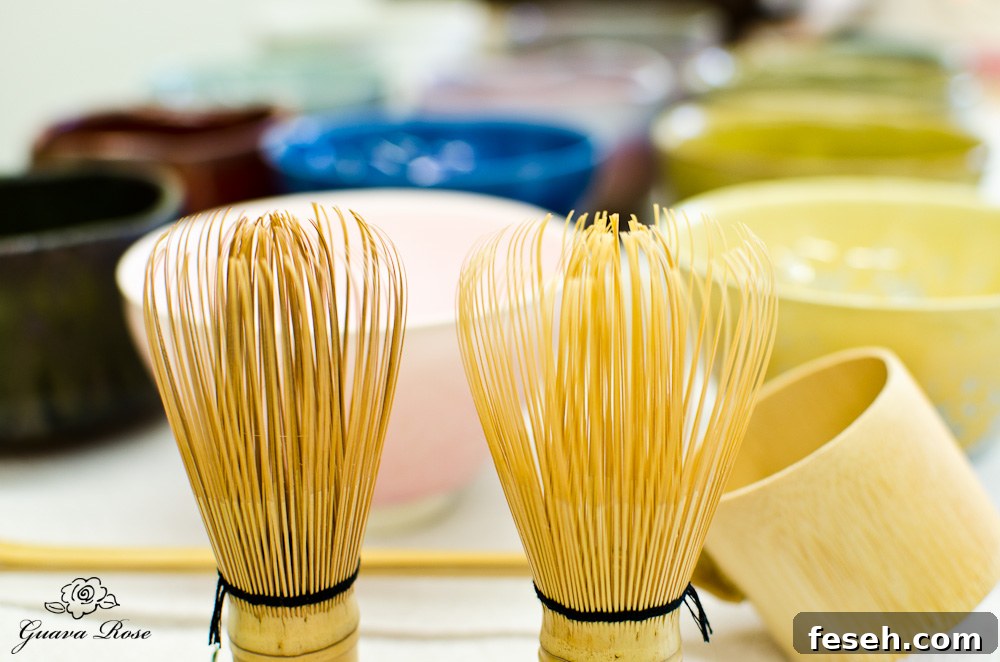
After the Japanese tea ceremony demonstration, the instructors began setting up for the students. The atmosphere shifted from performance to preparation as tools and utensils were arranged carefully for hands-on practice.
Here the women unpack and lay out everything on the school desks, creating individual stations so each student could follow the ceremony step by step.
The tea bowls were stored and transported in wooden boxes to protect their delicate finishes and shapes.
While some tea bowls can be very expensive, these used for the demonstration were chosen for durability and ease of handling, not for high value.
For the group tasting, matcha was prepared at half strength so newcomers could appreciate the flavor without it being overpowering.
Preparing matcha for a large group requires time and attention. Each scoop, whisk, and pour is performed with intention to ensure consistency.
Careful ladling and precise pouring are part of the etiquette, even when serving at simple tabletop stations.
Once prepared, the bowls were placed on trays and readied for serving. Everything was arranged with respect for both form and function.
Traditional sweets, manju, were offered first to complement the bitter notes of matcha and to cleanse the palate before drinking.
Tea was served with a bow, demonstrating respect between host and guest. Each gesture in the ceremony communicates mindfulness and gratitude.
Students received instruction on proper etiquette, including how to hold and rotate the tea bowl to avoid drinking from its front and to show appreciation for the vessel.
Before drinking, students thanked the host with the phrase “Otemae o choudai itashimasu,” acknowledging the care taken to prepare the tea.
Bowls were then turned clockwise by two quarter turns so the front of the bowl would face away while drinking.
Students drank the matcha, some audibly enjoying it with enthusiastic slurps—part of expressing appreciation for the flavor.
After drinking, the bowls were turned back counterclockwise by two quarter turns to return them to their original orientation.
Participants then took a moment to admire the bowls, appreciating their shape, glaze, and the craftsmanship behind each piece.
Because only half the students could be served at once, the bowls were rinsed and dried between rounds. In traditional practice, these bowls are rinsed with hot water only—soap is not used so as to preserve the tea’s aroma and the bowl’s surface.
Mayumi was honored with the name “Sohei” in recognition of her advanced training in chanoyu, the way of tea.
Left to right: Sohei (Mayumi) Kagami, Kiyomi Buchanan (Sakura Gakuen Sensei), Mariko Sawada, and Etsuko Tsukano
Many thanks to these women for sharing their knowledge and guiding participants through a respectful, authentic experience of the Japanese tea ceremony.