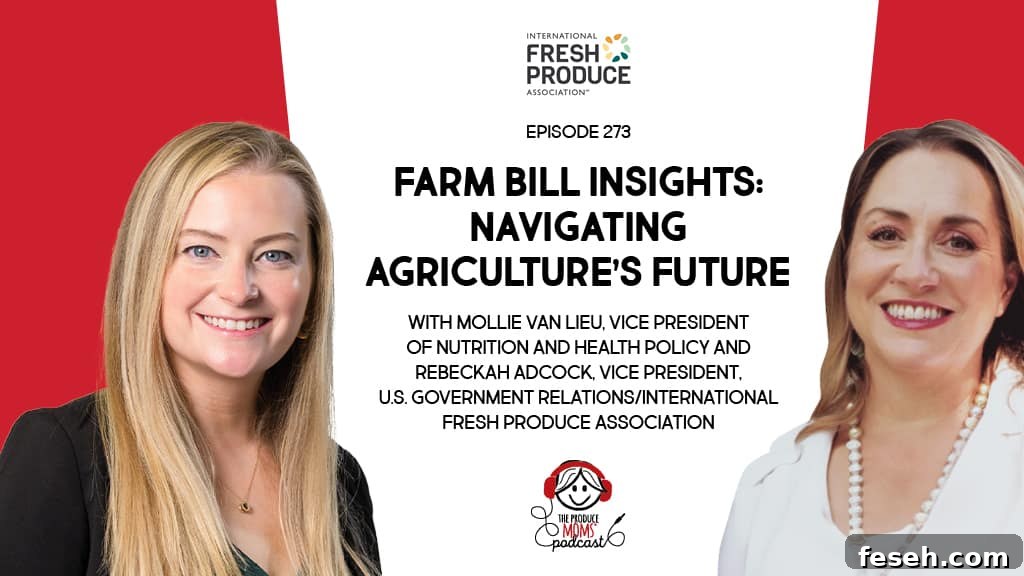
Agriculture is central to our nation’s prosperity, and the Farm Bill shapes the direction of this vital sector. As reauthorization approaches, the International Fresh Produce Association (IFPA) is actively engaging to ensure the legislation reflects the evolving needs of growers, rural communities, and public health. In this episode, IFPA’s Mollie Van Lieu, Vice President of Nutrition and Health, and Rebeckah Adcock, Vice President of US Government Relations, discuss IFPA’s priorities for the upcoming Farm Bill reauthorization and the key issues they are advancing.
Transcript
Introduction
Lori Taylor welcomes listeners to the Produce Moms podcast and introduces guests Rebeckah Adcock and Mollie Van Lieu from IFPA. Rebeckah leads government relations for the fresh produce and floral sectors, while Mollie focuses on nutrition and child health policy. Lori highlights the influence of the Farm Bill on the U.S. food supply and the importance of IFPA’s advocacy work.
What is the Farm Bill?
Rebeckah explains that the Farm Bill has evolved since the 1930s. Originally focused on commodity crops, it now covers a wide range of USDA responsibilities—conservation, crop insurance, rural development, forestry, energy, food safety, and more. The Farm Bill is the federal government’s largest investment in agriculture and food, and specialty crops and produce are important components of that investment.
Specialty Crops and Fresh Produce
“Specialty crops” in Washington parlance refers to crops outside traditional row crops—fruits, vegetables, nuts, and many processed products. The fresh produce industry is part of this broader specialty crop sector and works collaboratively on issues that benefit the full range of specialty crops as well as priorities specific to fresh produce.
Top Priorities for the Farm Bill
Rebeckah outlines IFPA’s major priorities for the reauthorization:
- Risk management: Expand meaningful crop insurance options for specialty crops and produce. Current options are limited or unavailable, leaving growers vulnerable to weather and market shocks.
- Access to programs: Adjust eligibility rules (such as AGI calculations) so specialty crop producers, who operate differently than commodity farms, can participate in grants, cost-share programs, disaster assistance, and conservation programs.
- Research & innovation: Increase funding for the Specialty Crop Research Initiative and other research programs—especially in mechanization and automation—to help relieve labor pressures and improve productivity.
- Labor solutions: Address the need for a stable, legal farm workforce and modernize pathways for seasonal and temporary workers to reduce shortages and help control food price volatility.
Nutrition & Health Priorities
Mollie and Rebeckah discuss the nutrition title of the Farm Bill and how the legislation affects dietary quality and food access for all Americans. Key focus areas include:
- SNAP enhancements and incentives to increase fruit and vegetable purchases—examples include “double up” type programs and efforts to expand participation and statewide implementation.
- Produce prescriptions: Modest investments and research can help scale produce prescription programs and generate evidence for health systems to adopt them.
- Fresh Fruit and Vegetable Program (FFVP): A long-running, evidence-backed exposure program for school children that reduces childhood obesity and introduces kids to new produce. IFPA advocates to maintain and expand funding so more schools can participate.
- Procurement reform: USDA buys billions in food for food banks and federal programs but currently purchases a narrow set of commodities. IFPA urges USDA to modernize procurement to contract with supply chains experienced in fresh produce and expand the variety of domestically produced fruits and vegetables reaching food banks and other programs.
Funding vs. Goals
Rebeckah highlights a key tension: nutrition guidance often recommends fruits and vegetables to be half the plate, yet the farm bill dedicates a relatively small share of agricultural program funding to specialty crops and produce. Even when including nutrition programs, investment in produce remains modest. Increasing that investment is central to IFPA’s advocacy.
Labor, Immigration, and Affordability
Labor remains a top concern. Rebeckah explains how workforce shortages and changing labor dynamics contribute to food price increases and volatility. IFPA supports realistic, secure, and modernized pathways for farm labor that balance agricultural needs with border security and immigration policy. Mechanization and automation are also critical components to improve efficiency and reduce dependency on limited labor pools.
Reauthorization Process and Timing
The Farm Bill is typically reauthorized every five years. If new legislation isn’t ready by expiration, Congress often passes short-term extensions before final passage. Rebeckah notes that while timing can slip, the Farm Bill reliably passes because it affects every congressional district.
Why the Farm Bill Matters for Everyone
Both guests emphasize that farm and food policy affects all Americans—producers and consumers alike. The Farm Bill influences what is grown, how it is supported, and what options are available and affordable at the grocery store and through federal nutrition programs. IFPA urges consumers, producers, and advocates to voice support for stronger investment in specialty crops, better procurement, and policies that improve access to fruits and vegetables nationwide.
How to Get Involved
Rebeckah encourages engagement: reach out to your lawmakers, participate in grassroots efforts, and join events such as IFPA’s March on Washington. Industry members and everyday consumers can make a difference by communicating to members of Congress that investment in fruits and vegetables matters for health, local economies, and national food security.
Closing
Lori thanks Mollie and Rebeckah for their insights. The conversation underscores the importance of advocacy and collaboration as IFPA and its members press for Farm Bill provisions that strengthen specialty crops, expand nutrition access, modernize procurement, support research, and address labor challenges. The episode closes with an invitation for listeners to stay engaged and help get more fruits and vegetables on every table.
How to get involved
- Join The Produce Moms Group on Facebook and continue the discussion every week!
- Reach out to the Produce Moms team to share where you are in life and business and find ways to engage with IFPA’s advocacy efforts.